Here's a presentation I gave on Friday to new Humanities research students based on my own experience of Masters/PhD based on a blog I wrote about 6 months ago.
Tuesday, March 15, 2011


Tuesday, March 1, 2011
Word of the Week
I periodically have a word of the week. It is often valid for longer than a week, and I don't have one at all times, but "Word of the Week" is catchier than "Word of an Indeterminate Period of Time". I also have a whiteboard next to my desk. So I write my word of the week on the whiteboard and leave it there until it soaks into my brain. Previous words of the week (or word of the weeks) include epistemology, ontology, hyponomy, and methodological framework. My current word of the week is 'prosody'. I think I've got my head around it, but I haven't quite totally digested the meaning - it still feels forced and unnatural. So on my whiteboard it shall stay a while longer.
Friday, February 18, 2011
Musemes and layers of signification
Permit me an idle musing. I need to think something out and sometimes that works better in text. Oh, and that's musemes not museums.
I have a stack of books on my desk relating to semiotics, music and musical discourse. I don't expect them to be of any use other than to establish how my approach differs from the majority of semiotic approach to music. At least that's what I'm hoping and it should (should) be fairly straight forward: they all seem interested in explaining how the sound of music has meaning like a language. My baseline (bassline? forgive the pun) response to this is that music is analogous to language, but only analogous, but I won't go into that right now. Bohlman and Cook have discussed this better than I shall. But before we even get to that, my approach differs in what mode (in the linguistic not musical sense) of music I'm looking at, because I'm interested in the semiotics of music as it relates to written music. (That's the problem with the word 'music' - it is at once an audio experience, a participatory experience, a recording, written directions for playing music and a whole host of other things.) For the purposes of my study into academic student writing, I'm trying to relate the meaning in the words to the meaning of the music notation incorporated in the texts.
The reading that has prompted this blog mentions a term used by Seeger and Tagg: musemes - musical morphemes. A morpheme is the smallest unit of meaning; so 'hat' is one morpheme, but 'hats' has two morphemes - one for 'hat' and 's' to indicate plurality. So a museme is the smallest unit of musical sense. Now I haven't read much further to understand just what they mean by this, though I understand it to involve intonations, intervals and so on. However it made me think - my problem with thinking about the semiotics of music from a traditional saussurian sense is that it's very difficult to identify the smallest unit of musical sense.
One might suggest the smallest unit of musical sense is a single note. Take for example the following note:
 Let us assume there is a treble clef preceding this note at some point. The note would therefore be an F. Or more precisely, its pitch would be F. This is not the only meaning realised in this representation. By its colour and shape, we also identify it as a crotchet, or quarter-note, which means that it should be played for the duration of a single beat. Just as 'hats' had two morphemes, so this single note has two meanings - pitch and note value.* So far so simple.
Within a real context however, these notes do not occur in isolation, just as words in a language do not occur in isolation. I come from a school of linguistics which insists that language be studied in real world contexts, or more specifically, texts. And so if we put the note in a context we might find something like this:
 Let us specify our F to be on the first beat in bar 6. Our friendly F which in isolation had two layers of meaning - pitch and note value - now has several other layers of meaning that an analyst may comment on. It has intervallic relation with the notes which precede and follow it: it is the same note as the four preceding it, and is then followed by a B natural. When I tried to clarify this interval with my brother without giving him the context he wrote '"Tritone" augmented 4th or diminished 5th'. Despite this sequentiality, it would not be played in isolation and thus has a scale degree of a flat 7 to the chord played by other parts and indicated in the notation by the G7 written over the stave. I introduced this note as being on the first beat of bar 6 - thus we find added rhythmic, intonation and contextual information. Rhythmic, as it is the first beat of four-beat bar; intonation, as the first beat in four-four rhythm is habitually emphasised; and contextual as we note where it comes within the context of the whole piece. I haven't even mentioned yet that this piece is a broadway tune and also a jazz standard, or on what instrument it is played.
And so we find layers of signification occuring with a single note. What is the smallest unit of meaning? And how are some of these qualities indicated? An educated musician would be able to identify all of these qualities and even more just by looking at the piece of music and yet how precisely can we pinpoint how this information is conveyed? By spatial layout as well as contextual generic knowledge?
And that's why I feel the approach of multimodal, or multisemiotic, analysis, stemming as it does from Systemic Functional Linguistics (SFL), is useful. SFL takes a multifunctional, stratified approach to language, understanding the same text to have experiential (relating to the world of experience, content), interpersonal (relating to the relations between reader and writer, or speaker and listener, or composer and performer and analyst) and textual (relating to the construction of the text as a whole) meanings simultaneously.
Now I just have to write a dissertation about it and explain it more academically.
*Disclaimer: I should check all my music terminology with a musicologist/musician before I publish them, but for the purpose of the blog just go with me and let me know if I've severely misrepresented.
I have a stack of books on my desk relating to semiotics, music and musical discourse. I don't expect them to be of any use other than to establish how my approach differs from the majority of semiotic approach to music. At least that's what I'm hoping and it should (should) be fairly straight forward: they all seem interested in explaining how the sound of music has meaning like a language. My baseline (bassline? forgive the pun) response to this is that music is analogous to language, but only analogous, but I won't go into that right now. Bohlman and Cook have discussed this better than I shall. But before we even get to that, my approach differs in what mode (in the linguistic not musical sense) of music I'm looking at, because I'm interested in the semiotics of music as it relates to written music. (That's the problem with the word 'music' - it is at once an audio experience, a participatory experience, a recording, written directions for playing music and a whole host of other things.) For the purposes of my study into academic student writing, I'm trying to relate the meaning in the words to the meaning of the music notation incorporated in the texts.
The reading that has prompted this blog mentions a term used by Seeger and Tagg: musemes - musical morphemes. A morpheme is the smallest unit of meaning; so 'hat' is one morpheme, but 'hats' has two morphemes - one for 'hat' and 's' to indicate plurality. So a museme is the smallest unit of musical sense. Now I haven't read much further to understand just what they mean by this, though I understand it to involve intonations, intervals and so on. However it made me think - my problem with thinking about the semiotics of music from a traditional saussurian sense is that it's very difficult to identify the smallest unit of musical sense.
One might suggest the smallest unit of musical sense is a single note. Take for example the following note:

Within a real context however, these notes do not occur in isolation, just as words in a language do not occur in isolation. I come from a school of linguistics which insists that language be studied in real world contexts, or more specifically, texts. And so if we put the note in a context we might find something like this:
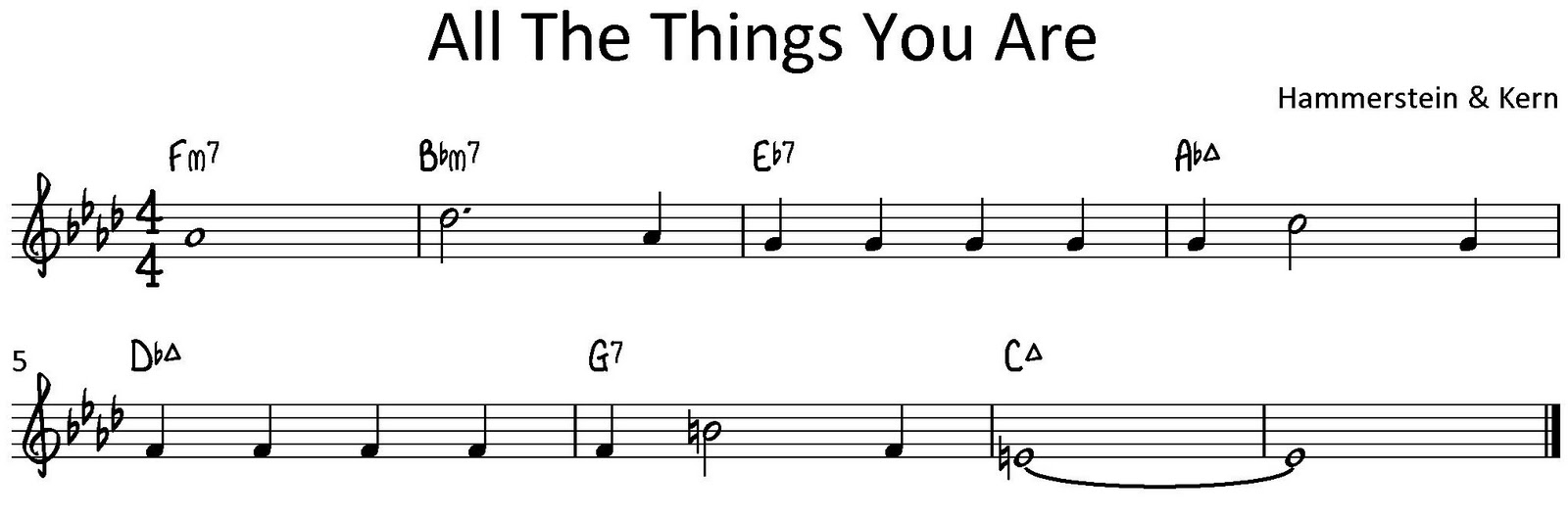
And so we find layers of signification occuring with a single note. What is the smallest unit of meaning? And how are some of these qualities indicated? An educated musician would be able to identify all of these qualities and even more just by looking at the piece of music and yet how precisely can we pinpoint how this information is conveyed? By spatial layout as well as contextual generic knowledge?
And that's why I feel the approach of multimodal, or multisemiotic, analysis, stemming as it does from Systemic Functional Linguistics (SFL), is useful. SFL takes a multifunctional, stratified approach to language, understanding the same text to have experiential (relating to the world of experience, content), interpersonal (relating to the relations between reader and writer, or speaker and listener, or composer and performer and analyst) and textual (relating to the construction of the text as a whole) meanings simultaneously.
Now I just have to write a dissertation about it and explain it more academically.
*Disclaimer: I should check all my music terminology with a musicologist/musician before I publish them, but for the purpose of the blog just go with me and let me know if I've severely misrepresented.
Tuesday, February 15, 2011
Unofficial milestone
I had one of those moments the other day which really made me feel
like a PhD student; I got feedback from my supervisor on an article
I'm writing. Somehow in the middle of going through his handwritten
notes and clarifying the odd illegible word, I felt like I know what I
know and now I really know it and I'm okay with what I don't know. Now
that I write it down it sounds far less significant. But there's
something about writing something down which makes it real in a
different way - just like I'm writing this blog now. I'm probably
biased because this is part of my topic, but written knowledge is
different from other types of knowledge. I've worked in a nursing home where if something isn't documented, it didn't happen, or can't happen. The written word says it is so, it was so and it shall be so. So just as the jazz students I studied attained different knowledge writing about music than when
they're playing it, so I reach different conclusions about their
writing when I write about it than when I talk or think about it, or
read it or present on it or analyse it. So now that I've written about what I know, I now know it more than I did before. Next milestone: getting it published and thereby getting other people to know it.
--
Sent from my mobile device
like a PhD student; I got feedback from my supervisor on an article
I'm writing. Somehow in the middle of going through his handwritten
notes and clarifying the odd illegible word, I felt like I know what I
know and now I really know it and I'm okay with what I don't know. Now
that I write it down it sounds far less significant. But there's
something about writing something down which makes it real in a
different way - just like I'm writing this blog now. I'm probably
biased because this is part of my topic, but written knowledge is
different from other types of knowledge. I've worked in a nursing home where if something isn't documented, it didn't happen, or can't happen. The written word says it is so, it was so and it shall be so. So just as the jazz students I studied attained different knowledge writing about music than when
they're playing it, so I reach different conclusions about their
writing when I write about it than when I talk or think about it, or
read it or present on it or analyse it. So now that I've written about what I know, I now know it more than I did before. Next milestone: getting it published and thereby getting other people to know it.
--
Sent from my mobile device
Friday, December 10, 2010
Doing music
I have been reading about music. It’s metaphorical, philosophical, ontological, epistemological, psychological and aesthetic. The question, “What is music?” seems to engender what it is to listen to music, or what it is we are listening to. Another book talked about how musicians (and non-musicians for that matter) imagine music.
When I mentioned to a friend who is a Physics graduate that I had been reading about what is music, he wrote, “you mean about how music is a combination of sound waves with varying numbers of nodes to determine the pitch and the brain recognises certain patterns within the nodal numbers and converts that into a feeling of either melodious or disharmonious”.
I’m happy to leave the question of what is music to other people. What I’m interested in is how does music. By which I do not mean the how the sounds are interpreted by our brains. I mean how do you do music. How does one music (verb)?
Why is this relevant? I am studying music students, focusing on their literacy. By literacy we can mean a range of things, from the traditional and etymological sense of reading and writing, to modern sense of technological literacies to deal with how we interface with computers and oral literacies of the various ways of speaking and listening. So it seemed to me necessary to consider what else the students are doing other than literacy.
I asked my uncle, who is a professional musician, and currently the director of music at a private school. I wrote, “If literacy is reading and writing, and oracy is speaking and listening, what is playing music?” He wrote, “Fun!”
I find myself shunted between two points of view – a highly complicated psychological/scientific/philosophical perspective or the Fats Waller/Louis Armstrong perspective of “If you don’t know don’t mess with it!”
And so, if you’ll pardon the pun, I had to improvise.
When I mentioned to a friend who is a Physics graduate that I had been reading about what is music, he wrote, “you mean about how music is a combination of sound waves with varying numbers of nodes to determine the pitch and the brain recognises certain patterns within the nodal numbers and converts that into a feeling of either melodious or disharmonious”.
I’m happy to leave the question of what is music to other people. What I’m interested in is how does music. By which I do not mean the how the sounds are interpreted by our brains. I mean how do you do music. How does one music (verb)?
Why is this relevant? I am studying music students, focusing on their literacy. By literacy we can mean a range of things, from the traditional and etymological sense of reading and writing, to modern sense of technological literacies to deal with how we interface with computers and oral literacies of the various ways of speaking and listening. So it seemed to me necessary to consider what else the students are doing other than literacy.
I asked my uncle, who is a professional musician, and currently the director of music at a private school. I wrote, “If literacy is reading and writing, and oracy is speaking and listening, what is playing music?” He wrote, “Fun!”
I find myself shunted between two points of view – a highly complicated psychological/scientific/philosophical perspective or the Fats Waller/Louis Armstrong perspective of “If you don’t know don’t mess with it!”
And so, if you’ll pardon the pun, I had to improvise.
Monday, November 29, 2010
In defence of macgyvering
I had my annual review the other day. It contained the usual moments of supreme politeness, justification, paperwork and so on. And then smack-bang in the middle of it, I found myself defining the word "macgyvering".
The context is thus: Nobody* has analysed what I'm analysing (music notation within academic texts). What people have analysed (images, layout, movies, sound, music as auditory experience, gesture, mathematical notation) isn't quite like what I'm analysing. So in order to construct an analytical framework, I have to adjust, tweek or cobble together a framework based on those created by people who already have their PhDs, rather than making one up myself. On a good day, I call this macgyvering a framework. On a bad day, it's more like frankenstein's monster.
In the middle of talking about timeframes with the review panel, I commented that the framework I hoped to use wasn't quite right and it took me longer to macgyver a new framework than I had expected, and I still might adopt a new one. The Postgrad Coordinator asked about the word macgyver - I explained it, I confirmed that yes, it was based on a tv show and in the end I was told not to use it in my thesis.
What is macgyvering for those of you who don't know? Well, the Urban Dictionary defines it as "To tinker, using items not normally used for this purpose." It originated from a tv show, MacGyver, in which the protagonist, MacGyver, played by Richard Dean Anderson, would use everyday items he found to get himself out of dangerous situations just in time. And so a toilet roll, a bit of duct tape and a palm leaf became a fully functioning helicopter, able to fly him and whoever needed rescuing away from the bad guys. Think a cross between Indiana Jones and Scrap Heap Challenge. Who am I kidding? You're unlikely to be familiar with those two but not MacGyver.
But I was thinking about it after, and I think that to macgyver is more than to 'use items not normally used for this purpose' - it is to create something which is more than the sum of its parts. The fun thing about the tv show was that it could be wildly improbable and unscientific**. Mythbusters has busted some of the macgyverisms used in the show.
So if I frankenstein an analytical framework, I cut up other frameworks into pieces and join them together, and create something ugly which doesn't quite work like the original and leads to mobs with pitchforks and flaming torches trying to destroy it.
But if I macgyver a framework, I create a beautiful thing which works impossibly well.
At the end of the day, though, I won't use the word in my thesis, though I hope the final product is nonetheless beautifully macgyvered. But I won't promise that it won't appear in any presentations I give.
*As far as I've been able to find so far. If you know of any research into it - from a musical or linguistic perspective - please tell me!
**I have to admit that my memories on this front are a bit hazy, but then I was only little when this was on tv.
The context is thus: Nobody* has analysed what I'm analysing (music notation within academic texts). What people have analysed (images, layout, movies, sound, music as auditory experience, gesture, mathematical notation) isn't quite like what I'm analysing. So in order to construct an analytical framework, I have to adjust, tweek or cobble together a framework based on those created by people who already have their PhDs, rather than making one up myself. On a good day, I call this macgyvering a framework. On a bad day, it's more like frankenstein's monster.
In the middle of talking about timeframes with the review panel, I commented that the framework I hoped to use wasn't quite right and it took me longer to macgyver a new framework than I had expected, and I still might adopt a new one. The Postgrad Coordinator asked about the word macgyver - I explained it, I confirmed that yes, it was based on a tv show and in the end I was told not to use it in my thesis.
What is macgyvering for those of you who don't know? Well, the Urban Dictionary defines it as "To tinker, using items not normally used for this purpose." It originated from a tv show, MacGyver, in which the protagonist, MacGyver, played by Richard Dean Anderson, would use everyday items he found to get himself out of dangerous situations just in time. And so a toilet roll, a bit of duct tape and a palm leaf became a fully functioning helicopter, able to fly him and whoever needed rescuing away from the bad guys. Think a cross between Indiana Jones and Scrap Heap Challenge. Who am I kidding? You're unlikely to be familiar with those two but not MacGyver.
But I was thinking about it after, and I think that to macgyver is more than to 'use items not normally used for this purpose' - it is to create something which is more than the sum of its parts. The fun thing about the tv show was that it could be wildly improbable and unscientific**. Mythbusters has busted some of the macgyverisms used in the show.
So if I frankenstein an analytical framework, I cut up other frameworks into pieces and join them together, and create something ugly which doesn't quite work like the original and leads to mobs with pitchforks and flaming torches trying to destroy it.
But if I macgyver a framework, I create a beautiful thing which works impossibly well.
At the end of the day, though, I won't use the word in my thesis, though I hope the final product is nonetheless beautifully macgyvered. But I won't promise that it won't appear in any presentations I give.
*As far as I've been able to find so far. If you know of any research into it - from a musical or linguistic perspective - please tell me!
**I have to admit that my memories on this front are a bit hazy, but then I was only little when this was on tv.
Sunday, October 24, 2010
I think I want to be a linguist
Well the last month has run the gamut of emotions, at least as far as my PhD was concerned.
I prepared to present at a conference and felt immensely unworthy and ill-prepared. My first attempt at my presentation bored me. I analysed and collated my data only to feel as if I was stating the obvious.
I attended workshops before the conference and the conference itself and felt immensely inspired and motivated to read and analyse and research.
I attended presentations at the conference and heard about research that I'd love to participate in and thought for the first time, "I think I want to be a linguist".
For the first time also I reached a high point in my PhD. Not as in a climax or a highlight, but a moment from which I could look back on what I've done and see ahead to what I might do. I realised I was half way through my degree. That I had one year left of analysis and research, then six months of thesis writing, and then I'd be done. That scared me at first. I realised I had two months to completely shift focus to another area of my research and prepare to attend two conferences, which I still didn't know how I would fund (I've since pulled out of one). But I could see what I wanted to do, I could trace the steps. I thought about a gantt chart (stupid things) to plan my progress. I had to do one anyway for my annual review anyway. One of the good things about getting into this degree was simply the peace of mind of knowing what I'd be doing for a few years. For several years before, I never knew what I'd be doing from year to year. And that's really irritating when you want to sign up for a 24 month plan for a mobile phone, or decide whether to rent a place and live independently, or buy anything that you might not use if you went away. But at the same time, within the degree, I feel like I've kind of stumbled from one topic to another. But now I can see what I've covered, and I know what I need to do and what I need to look at before I can write. One of the most perspective-shifting pieces of advice I got wasn't even aimed at me, but relayed from a friend who it was told to: Just do what you've got to do to to finish your PhD. And that reassured me. We don't have to change the world with our PhD. This gives us the qualification to do more. And to get paid more to do it!
And then in the week after the conference I got a bit sick and couldn't quite do everything I wanted. Books couldn't be borrowed or had to be read in the library. I didn't have access to photocopiers. And so everything slows down until you're back to your normal level of apathy, where the urgency dissipates and the momentary compulsion isn't quite followed by the long-term commitment and responsibility that you might hope.
I still haven't sat down and charted how many months I'll allocate to each area I need to cover. I'm still trying to read the things I need to read before I can do the things I need to do before I can prepare my presentation for the conference in six weeks. But at least I know what I need to do and I know what I want to say and I have a glimpse, just a glimpse, of creating something new and shiny and bright. Something I can be proud of and something from which, if I'm lucky, I might just forge a career.
Perhaps coincidentally, two nights ago a friend called from France to offer me her job in six months' time when she will be promoted. It's a marketing job, so I would be selling out a little to take it. And I won't have finished my PhD by then. And I'm not sure that I want to live in France. But it's good to know the opportunities are out there and I'm not the only one who sees the benefits of being, for better or worse, a linguist.
I prepared to present at a conference and felt immensely unworthy and ill-prepared. My first attempt at my presentation bored me. I analysed and collated my data only to feel as if I was stating the obvious.
I attended workshops before the conference and the conference itself and felt immensely inspired and motivated to read and analyse and research.
I attended presentations at the conference and heard about research that I'd love to participate in and thought for the first time, "I think I want to be a linguist".
For the first time also I reached a high point in my PhD. Not as in a climax or a highlight, but a moment from which I could look back on what I've done and see ahead to what I might do. I realised I was half way through my degree. That I had one year left of analysis and research, then six months of thesis writing, and then I'd be done. That scared me at first. I realised I had two months to completely shift focus to another area of my research and prepare to attend two conferences, which I still didn't know how I would fund (I've since pulled out of one). But I could see what I wanted to do, I could trace the steps. I thought about a gantt chart (stupid things) to plan my progress. I had to do one anyway for my annual review anyway. One of the good things about getting into this degree was simply the peace of mind of knowing what I'd be doing for a few years. For several years before, I never knew what I'd be doing from year to year. And that's really irritating when you want to sign up for a 24 month plan for a mobile phone, or decide whether to rent a place and live independently, or buy anything that you might not use if you went away. But at the same time, within the degree, I feel like I've kind of stumbled from one topic to another. But now I can see what I've covered, and I know what I need to do and what I need to look at before I can write. One of the most perspective-shifting pieces of advice I got wasn't even aimed at me, but relayed from a friend who it was told to: Just do what you've got to do to to finish your PhD. And that reassured me. We don't have to change the world with our PhD. This gives us the qualification to do more. And to get paid more to do it!
And then in the week after the conference I got a bit sick and couldn't quite do everything I wanted. Books couldn't be borrowed or had to be read in the library. I didn't have access to photocopiers. And so everything slows down until you're back to your normal level of apathy, where the urgency dissipates and the momentary compulsion isn't quite followed by the long-term commitment and responsibility that you might hope.
I still haven't sat down and charted how many months I'll allocate to each area I need to cover. I'm still trying to read the things I need to read before I can do the things I need to do before I can prepare my presentation for the conference in six weeks. But at least I know what I need to do and I know what I want to say and I have a glimpse, just a glimpse, of creating something new and shiny and bright. Something I can be proud of and something from which, if I'm lucky, I might just forge a career.
Perhaps coincidentally, two nights ago a friend called from France to offer me her job in six months' time when she will be promoted. It's a marketing job, so I would be selling out a little to take it. And I won't have finished my PhD by then. And I'm not sure that I want to live in France. But it's good to know the opportunities are out there and I'm not the only one who sees the benefits of being, for better or worse, a linguist.
Subscribe to:
Posts (Atom)