Thursday, February 20, 2014

Asking about the thesis: 5 rules, 4 analogies and a self-aware thesis

Before I started writing my thesis, I made a twitter account for it. I recently downloaded the archive of its tweets to my excessive amusement. I forgot at one point it tweeted in frustration:

@JodiesThesis: Also, if you don't want people to ask about me, STOP TALKING ABOUT ME!!!

I am now one of those people who can ask a PhD student (or Masters student) about their thesis without currently working on a thesis myself. Now that I'm on the other side though, the taboo on asking doesn't seem as obvious as when I was inside. 
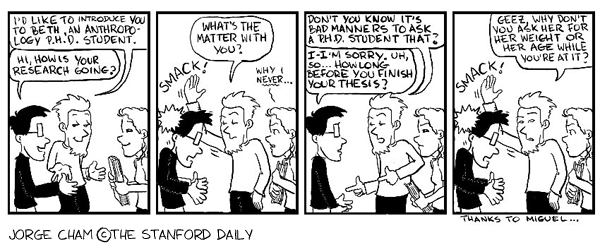

This Golden Era* PhD Comic says it all really
*Golden Era = before my thesis


A friend just messaged me that she shared my post on "Rules for talking with a thesis writer" to a group of friends recently after explaining that asking about the thesis was not helpful. She was glad to wake the next day to messages of loving support.

So I thought I'd reflect on how I successfully ask about the thesis now that I am not bound by concurrent suffering.


1. I ask when I'm available to listen at length
I ask when I'm catching up for coffee, not when I'm chatting on facebook. I ask when I haven't seen them for a while, not when I see them every week.

Marathon runners
...uh, where are the women? That's not supposed to be part of the metaphor

Consider the analogy of the PhD as a marathon. You may have certain checkpoints where you assess how you're going, whether you're ahead or behind your goal time, whether you need to speed up in the next leg, or pace yourself for the end. You don't want to be asked every 100m how it's going. And that's what it can end up with thesis writers - maybe you don't ask every day, but somebody does. And it gets tedious.

2. I ask when I can encourage without dismissing
I tell them they can do it, but I don't deny their fears. I don't broadly sweep it under a generalised opinion that they're smart so therefore they must be able to do it. There are very smart people who have not finished PhDs. An important part of the thesis is managing the stress, guilt, and pressure, not just sitting down and writing endlessly. As I drew at one point, it feels more like battling a dragon than typing.

At the same time I keep an eye out for Impostor Syndrome. Then I ENCOURAGE WITH CAPSLOCK SO THEY HAVE TO BELIEVE ME!

3. I ask after we've talked about other things
The PhD does start to consume you completely and I know in the last month or two before I submitted, I didn't have room in my head to think about other things. My friend and I would be having coffee, talking about other things then zone out and suddenly burst out with an argument we could use in our thesis. We'd nod agreement to each other without really understanding more than vaguely then resume discussing coffee, or annoying people, or the weather, or all the things that will be better once we take over the university.

However here I think the useful analogy is not PhD as a full-time job, but PhD candidate like a stay-at-home parent.

Stay-at-home thesis-writing mum!
Image courtesy of Lean In / Getty Images collaboration to provide non-stereotyped stock photos of women

While they love their child (the thesis), they spend 24 hours a day thinking about it. They have their sympathetic parents group (PG study group/supervision panel/shut up and write crew) to talk to at length about it. And when they go out for coffee with someone from outside that world, it's really really nice to talk about something else for a while. Chances are they'll inevitably draw the conversation back to their Pride And Joy, but that's their choice. 

4. I know when not to ask
I don't ask if I know they're approaching an important deadline. I'll spend a whole hour talking about everything but the thesis - I'll ask about work, the family, the house, anything, because I know they don't need me guilt-tripping them into work.

The white rabbit is the thesis-writer's equivalent of an elephant in the room,
if the elephant was screaming "You're late! You're late! For a very important date!"


5. I ask because I've been there
The exception to the "Don't ask about the thesis" rule is that you can ask if you have first hand experience of writing a thesis.

I don't know exactly why. It's just a fundamental Truth.

However, between you and me, I think that if you take into account everything I've said, you can get away with asking.

Friday, February 14, 2014

Thesis Nuts and Bolts: Part 3: Printing and Binding FINAL COPY

This is the final blog in my trio this week on Thesis Nuts and Bolts. 

Now if you're in Adelaide and you ask your predecessors where to get your thesis bound, you'll probably hear that William Harley & Son Bookbinders is the only place in Adelaide which does thesis binding. It is in an old converted house just out of the city in Thebarton with a teeny reception window. I did try to look further; there are some interstate places that you could email your pdf to for printing and binding which I've heard do good work, but I was too nervous to trust Australia Post with My Precious or to trust colour choice when I couldn't see the materials in real life. 

Because we all know colour choice is the most important decision.

My mantlepiece-dweller
The other decisions you can make:

- Paper type/quality
- Title just on spine or extra for it on the front as well 
- A myriad of extra options: embossing, flourishes etc etc. 

The important thing is that it's a 24 hour service. No more no less. So if you drop it off at 3pm you can't pick it up at 9am the next day. (A student in front of me in the line wanted his sooner).

I got them to print as well as bind. Firstly because I wanted the final copy to be professionally printed and secondly because I was no longer at uni to exploit the printing facilities. I did get quotes from both WHarley and Whiteslaw (first link that appears if you google "thesis binding") so I could decide how many copies to get. I even made a spreadsheet (my dad was proud). At a rough count, of the 281 pages in my thesis, only 41 pages were black and white if I kept the coloured headings. This includes blank pages. However if I changed the headings to black, it would be 190 pages black and white, with 91 colour. It's a substantial difference. 

I changed the headings to black and white. 

I must say I was very happy with the result. It's quite lovely. Looks subtly better than the examination copy I printed on normal paper with the university printer.

Though this may be just part of the pregnancy analogy of thesis writing: I'm quietly convinced my thesis is prettier than anyone else's. 

I went to the printer's two days before I intended to submit. I took my brother along to help choose the colour, so the blue above is largely his choice, otherwise I would've been there for hours saying  "Blue? ... or Green? Blue?... or Green? Green? ... or Blue?" I took the file on a USB key (which I hung around my neck on a necklace to keep it close to my heart*) and when I copied it onto their computer, I opened it and scrolled through it for no particular reason. I then found a random university shield (presumably from one of the appendices) had replaced the label on an early figure. For no apparent reason. I panicked momentarily, considered leaving it, then confirmed I could email them the pdf to them that night and still get it in time.

Moral: It is worth going more than 24 hours before you need to. Because shit happens.

I was quietly convinced something would go horribly wrong, but nothing did. 

Another very important thing for the University of Adelaide students to be aware of is the THESIS ALLOWANCE.

Yes! They will reimburse you $840 for a PhD or $420 for a Masters for the printing and binding!
If you submit within candidature and if you were on a scholarship. 

The catch? You have to find the form! 

A colleague reminded me of it (thanks Margareta!) so I went looking. Could not find it for the life of me! So here's a direct link at the time of publishing. If however that doesn't work, search for "Thesis Allowance Claim Form" on the website. It ended up being located in the Grad Centre page (okay) under Forms & Information (makes sense) then under Nomination and Payment of Examiners (... WTF?!)

So even printing and binding five copies, with 91 colour pages per copy, the reimbursement covered my full costs.

Huge relief. Again I was quietly convinced my claim would be rejected even though there was no reason. 

Electronic version and copyright

The last important point to make is about the final electronic version. The part where you stick a pdf copy of your thesis on a CD, I'm sure you can handle. The tricky part is the copyright.

In my thesis I had diagrams that I'd either scanned in from books, or replicated, or adapted, or downloaded from the website (thanks LCT!). But more importantly I had oodles of music notation copied from the texts of the students I had studied. OODLES!

The tricky thing is that it's YOUR responsibility to obtain copyright permission for the online version. Finding out how to do that, and how that applied to notation students had transcribed of a bass line was hard. I asked around: three people referred me to a fourth who had referred me to the three people in the first place. Nobody really knew.

The clearest information I could find was this page from Monash University. Thanks Monash!

Top tip 1: Start researching any copyright permission you a) might need b) might be able to get earlier rather than later. After you submit your examination copy but way before you get your results. Because it can take months to obtain.

Top tip 2: If you can't, some anonymous librarian will remove the copyright material from your thesis pdf. You just have to give them a list.

In the end, the following contained content to be completely or partially removed from the online version of my thesis for copyright reasons:
  • 11 of 51 Tables
  • 20 of  39 Figures
  • 12 of 13 Examples
  • 2 of 21 Appendices
You see why I suggest you should look at it early.

It also means if you access the online version of my thesis, it will extensively discuss the multimodality of music notation without displaying any music notation. So if you're really interested, drop me an email and I'll send you a copy. 


So that's what I did for printing and binding. I hope that helps some of you Adelaideans know what to expect. If you have any questions drop me a line!

*true story.

Wednesday, February 12, 2014

Thesis Nuts and Bolts: Part 2: Printing and Binding EXAMINATION COPY

Often the only time near-submitters make contact with the outside world is to ask previous submitters where they went to print and bind the thesis. So I thought I'd spell out the options.

This is very specific to Adelaide and to University of Adelaide. But hopefully some of the issues will hold true of other places.

The rules are simply that you need to provide three hard copies of the thesis for examination plus an electronic copy on a CD. They recommend soft bound but not necessarily which type of binding.

You'll probably want a copy for yourself as well, and your supervisor(s) might want one as well. If they have to argue for you in moderating the examiner's reports, it helps for them to have a reference text.
For the final copy, you need to provide one hard bound copy and one electronic copy on a CD. (I'll discuss printing and binding the final copy in the next blog post).

There are a couple of choices.
1) Print the copies yourself and take the papers to get bound
2) Print with one service and bind with another service
3) Take the electronic file somewhere and get them to both print and bind

Printing
I printed the thesis myself. This was for two reasons. Firstly, I was having the problems I mentioned in the last post with random page breaks and printing it myself would allow me to keep an eye on it. Secondly, and most importantly, I had lots of colour in my thesis and that would've cost a fair amount to print. 

There are several considerations in printing it yourself though. If printing at home, you have to have oodles of ink and paper. There is a high chance you will run out of both. If printing on campus, do you have enough credit to print it at uni? I still did so that was fine. If using an office printer, remember you are going to be printing at least three copies of a very large document, so you are going to be majorly hogging the printer. Do consider who's going to be around and wanting to use the printer. For me, this was OK because I was printing in the evening when most had left, though my friend and I were taking turns printing.

Top tip: I wasted a ream of paper before I realised that saving the file as a pdf would display the file as it would be printed out, including any glitches. This may seem redundant; surely the print preview option does this. As I mentioned I had page breaks appearing, and there's a myriad of tiny things that only display when you print. So rather than print out several copies to check, save it as pdf, then go through it with a fine tooth comb.

Binding
Once I had printed my four copies (three to submit and one for me), I got them bound at the university's Image and Copy Centre. It only cost $8 per copy and I think the turn-around time was about an hour. A colleague had before me got copies comb bound and thermal bound to compare; her thesis was much bigger than mine, and she concluded the thermal bound was much much better. I agree with her recommendation although one caution is make sure they put a cardboard backing on it; I ended up with clear plastic on both covers and it looses some structural integrity. They did have convenient plastic CD sleeves which were handy to stick in the back (I had my corpus on a disc as an appendix). 

One of my examination copies, thermal bound

Things to be aware of: There are peak times for the Image and Copy Centre. If you're wanting anything done around the start of the semester, realise there will be thousands of course guides and reading packs being printed out. Contact them ahead of time so you know how much time to allow.

Alternatives
As I finished printing late one a Wednesday evening, I took the bundles of paper to Officeworks to get bound, thinking they might do a more professional job. However, it was the week before Christmas and they wouldn't be ready until the following Monday. I couldn't handle that long a wait, so took them to the ICC the next morning. So it is worth calling around various places and finding out not only how much it would cost but how long it will take.

If you are going to comb bind it, you can possibly do it yourself if you have access to a binder at an office. I did this with my honours thesis and it ended up a little wonky.

Some things to consider
Some places, like Officeworks, print black and white on one machine and colour on another. If you have a large amount of colour in your thesis, this might be an issue. One colleague had her thesis printed in black and white, then printed the colour pages herself and substituted them before getting it bound.

If you have submitted and have any tips or warning stories, please share them in the comments below!

So those are the tedious details of printing for examination. On Friday I'll publish my last post on the Thesis Nuts and Bolts by recounting the minutia of the examination copy. 

Monday, February 10, 2014

Thesis Nuts and Bolts: Part 1: Formatting

When the time comes to submit a thesis, there are so many decisions to make, so many little details to figure out, and so many guidelines to adhere to, that it can be overwhelming. When my time came, I asked my colleagues who had submitted within the previous twelve months everything I could think of about where and when and how. So in the spirit of passing on the information, I'm writing it all here for those of you submitting after me.

However, there is a LOT of information. So I'm making a week of it! Monday, Wednesday and Friday I'll be posting blogs about formatting, printing and binding the examination copy, and printing and binding the final copy!


Before I get into the nitty-gritty, though, some of this information will only be relevant to Australian PhDs, some only to Adelaideans, some only to University of Adelaide students. And even then, some of the official requirements may have changed so don't just rely on me.

At the very least, I hope you get forewarned of issues you may face and decisions you may have to make.

Formatting

I combed through the Thesis Specifications form to find the official requirements for formatting. They're easily summarised: 
  • The title page is content is prescribed.
    Note: on the final submitted copy you keep the original submission date (could not find this stated anywhere though!)
Title page

  • You must include a table of contents, an abstract, the originality declaration & library consent, and acknowledgements.
  • The wording of the declaration is prescribed. (See the Thesis Specifications page for latest wording)
    Note: you only have to use the publications declaration if you're doing a thesis by publication, not if you have previously published.
My declaration (wording for 2013)

  • The rest of the thesis should be a "clear and legible font", such as Arial Narrow 12 or Times 12.
  • Margins should be no less than 35 mm on inside edge and 15 mm on other edges.

That's it. 

So what this means is it can be single- or double-sided. There is no obligation to double space the body text. You can choose a non-Arial or Times font. You can have it size 11 or size 10 or size 11.5.

Top tip: Proofread all the ancillary information before the introduction very carefully. I have seen masters dissertations with sloppy typos in the acknowledgements or abstract. Even worse, I had a typo in my TITLE that I only noticed 2 hours after submission. I had prepared the title page several months before and it had an earlier wording. I had fastidiously checked every other part of the title page (I've seen also seen the month misspelt!) and I had played with various formats for the title (left-aligned, right-aligned, different font sizings), but I did not notice that it still said "legitimisation" instead of "legitimation" like my entire thesis. Let my facepalm be a lesson to you all.

What I did

Page 1 of my thesis

I used the Word defaults of calibri for the body and cambria for the headings with the attendant formatting variations for the various levels of headings. I also used cambria for excerpts from the texts I was analysing to differentiate them from quotes from references.
I used 1.15 spacing between lines, but 24pt spacing after paragraphs.
My margins were 4cm on the inside, 2.5cm on the outside, 2.54cm top and bottom.
I printed double-sided.
I used colour-coding in my analysis, and kept the default blue for the headings for the examination copy. 

I kept each chapter in separate files until I assembled them all in one giant Word file. (People will tell you this is Bad, but I had no problem).

Some implications to consider:

I was briefly tempted to use a free font I had downloaded; although it is lovely and would've visually distinguished my thesis from the mass, I couldn't load it on my university computer. When the computer can't read the font, everything gets messed up - paragraphing, pagination, aesthetics. Even as a pdf sometimes if the font is not loaded on the computer it can still be affected. So it's a safer bet to use a commonly installed font.
I heard recently that non-serif fonts like Century Gothic or Arial are easier to read on a computer screen. As all of our dissertations are electronically available these days, and most of our readers will read it on a screen of some sort, it's worth considering. 

Because I only had 1.15 spacing between lines and my margins weren't especially wide, I found it was aesthetically easier to read if I added a larger space between paragraphs (24pt).
Because I printed double-sided, I had to pay attention to the placement of the page number in the footer. I wanted it to be on the outside of the page (right side of the right page and left side of the left page). This is fairly easily done (just have different footers for odd and even pages), however you have to pay attention when you have section breaks and landscape pages as it can get out of whack. I also inserted some blank pages to ensure that the first page of every chapter was on the right hand page, as were the abstract, declaration, and acknowledgements.

Formatting gremlins:

I kept having seemingly random page breaks inserting themselves without my permission. It was only the day before I submitted that I figured out why it was happening. I had used cross-referencing extensively - I would insert a "cross reference" to an object (table, example, figure) so that it would automatically update the number if I rearranged things. When I was doing the final pagination (making sure objects did not break awkwardly over two pages or leave a single line of text on a page) I inserted page breaks to move objects to the next page. For some odd reason, if you insert the page break immediately in front of the caption label, the next time the file is refreshed (by closing and opening the file), it will ALSO insert a page break in front of the cross reference in text. I was left with a sequence like this:
Page 1: This can be demonstrated in
Page 2: Table 2 below.
Page 3: [Table 2].
I did my best to fix this but a few still slipped through to the examination copy, although I was purposefully not adding page breaks. However to my great embarrassment it was only after a solid hour of wrangling with it before the final submission that it suddenly occurred to me: the in text references no longer needed to be refreshable cross-references. THEY WEREN'T GOING TO BE CHANGED ANY MORE! So I just retyped them as plain text.

I tell you this in the hopes it will save the ream of paper I printed out trying to get it right.

I also had problems with images and labels moving around spontaneously between objects. I still don't know why that happened. I blame it on Thesis Gremlins. I can only recommend doing at least one read-through paying particular attention to objects and labels. It's too easy to skim over them.

So that's what I did for formatting. If you have any questions ask them in the comments. If you encountered any problems or want to share your stylistic choices, pleas share them in the comments.

On Wednesday I will post about the vagaries of printing and binding for examination!

Thursday, February 6, 2014

OPERATION: GAJette (Get A Job)

Hi everyone,

I'm looking for a job. If you know anyone who is looking to hire someone in the areas of communication and literacy, let me know or send them this link: au.linkedin.com/in/jodiemartin/ It has my official resumes and other interesting and relevant information about me.

To be precise: I'm currently interested in positions such as communication officer, copywriter, research assistant or literacy support officer. Or anything in between. I'm happy to move anywhere in Australia or the world.

Thank you to everyone who has been keeping their ear to the ground for opportunities for me so far. I do really appreciate it.

As a bit of fun, here is a stick figure CV I created, because job searching often is more soul-destroying than fun. Enjoy.

Saturday, November 23, 2013

Imposter Syndrome, Going Postal and book recommendations

My favourite book of the last couple of years is Going Postal by Terry Pratchett. It's one of the Discworld novels and in it the protagonist, Moist von Lipwig, is hanged for his crimes and then forced to take on the role of Postmaster and use all his skills as a conman, thief and trickster to make the post office functional let alone successful. And he invents stamps in the process.

I'd read a couple of Discworld novels but never quite gotten into them. I first saw the tv adaptation of Going Postal. Then I downloaded the electronic book. I now also have a hard copy, a french translation and I'm eyeing off the audiobook version despite it being almost four times as much as a paperback. 

Electronic copy
Hard copy
French translation


It was only on the second or third read-through that I realised why I loved the book so much: I identified with the main character. Not because he was a criminal, but because he spends the entire book feeling like a fraud and waiting for someone to bust him. But they never do. And when he does eventually confess to having no idea what he's doing, nobody believes him. 

Now I no longer feel like a total fraud. Most PhD students do at some point. But I am conscious of how much I don't know and expect someone to call me out on the things I'm not confident of. And when I tell people I don't know what I'm doing, to my great surprise they don't believe me. 

 My favourite quote (so favourite it is currently written on my fridge) is:
This is where his soul lived: dancing on the avalanche, making things up as he went along, reaching into people's ears and changing their minds.
I guess this is how I feel when I give a good presentation. Like people don't know how little I know, yet I'm pulling it off! I'm making sense! Or more realistically, it is only when I am changing people's minds that I realise I know what I'm talking about. On the other hand, when I'm less confident, I feel like I've been caught with my arm in people's ears before I've been able to reach their minds.

Awkward.

When I was in the middle of my PhD my friend gave me a book by Stephen Fry. I started reading it but didn't get far into it because it was too close to my reality to provide an escape - it was about a PhD student preparing his thesis for submission. So personally I couldn't recommend it for PhD recreational reading. 

Going Postal, however, has familiar themes for the PhD student and provides a decent escape while subtly suggesting 'Keep going. You may do some good, however inadvertently.' 

But why paraphrase? A few apt quotes:

"This was probably garbage, but it was good garbage!"

"Always keep moving. There may be something behind you."

"Run before you walk! Fly before you crawl! Keep moving forward!"*

"... Because if we fail, I'd rather fail really hugely."

For some strange reason, over my PhD I found this ambitious realism, this optimistic fatalism, hugely comforting.


*I actually used this quote recently talking to a PhD student who'd been offered an amazing opportunity but was feeling inadequate. 


EDIT: Forgetting I had scheduled this post to publish on Saturday, I coincidentally downloaded the audiobook on Saturday.

Wednesday, November 20, 2013

Working effectively: no guilt, less stress, and more mental health days

I was just talking to a friend about procrastination. She's trying to figure out the reason for her procrastinatory tendencies, ironically delaying finishing overdue work in the process. I started telling her about all the things I learnt last year working on my thesis about guilt and procrastination and managing stress and accountability, and I realised, I learnt an awful lot. Most importantly, the major thing I learnt last year was how I work effectively. I keep forgetting, though, so I thought I should write them all together in the one place.

While not all of these things may apply to you, hopefully you can identify with some points.

1. Guilt makes me less productive
Let's say I had intended to finish writing something by Monday, but hadn't. So Tuesday comes and I try to motivate myself by emphasising that it was supposed to be done by now. Inevitably I end up doing less on Tuesday than any other day of the week. I think in part it's because I subconsciously look for ways to cheer myself up so I am enthused to get to work, and before you know it I've read half the internet and achieved nothing and it's already 5pm so should I work late or call the day a write-off (pun intended)? I try to remind myself to let go of the guilt but sometimes plain forget to.

2. Know when to go home
Some days, around mid afternoon, I'd hit the wall. The brain wasn't responsive and I'd been staring at the same paragraph for half an hour, whether reading or writing. To push on or go home? That was the question. The challenge is knowing whether you really have hit the wall, or whether you've just tied your shoe laces together. I have to admit to relying a little more on coffee and energy drinks than I should've to kick start the focus, but the thesis got done and I've kicked that habit. But important to that was knowing when my brain had genuinely reached saturation point, and taking the hint.

Similarly you have to take care of yourself physically. For me I have to be careful of migraines. The weird thing with my migraines is how often at the start I would not think to do those things which are proven to stop migraines (take analgesia, stop staring at a bright screen, drink lots). So it was important to know when my body had had enough, and to recognise that a migraine, or tiredness, or whatever, would be sooner dealt with by going home than staying and working, or even staying and slacking off. This is an obvious point, but it's sad how easily we forget to eat when hungry, drink when thirsty, sleep when tired, or stretch when stiff and sore - and then we're surprised when we're not particularly productive. 

At other times I finished what I set out to achieve that day. Maybe I finished early, or maybe I finished later, but either way I'd be the tempted by the fact that if I kept working I'd be ahead tomorrow. Eventually I realised though that if I did keep working, the next day ended up disproportionately less productive: I'd sleep in, or just slack off, or both. So if you meet realistic targets, go home.

3. The sense of accomplishment lies
You know that inner warmth you get when you've achieved what you set out to achieve and made progress? It's a total illusion! Some days I spent only an hour working on the design for a slideshow, or in a flash figured out something I'd been struggling with, and the inner glow would light me up like fireworks. I'd feel like I deserved to call it a day, or at least take a break, maybe go buy myself something as a reward. Other days I worked long and hard, but didn't actually finish anything per se and there was no glow, no warmth, no sense of accomplishment. Even when I had measurable evidence of how much work I'd done, even if I did what I set out to do that day, even when I'd made progress, I didn't feel like I'd done enough. So don't trust the sense of accomplishment; find a different way to measure success, and then trust that instead.

4. Accountability and tomatoes 
And that brings me to tomatoes. If you haven't heard about pomodoro technique (25 mins work, 5 mins break) or shutupandwrite, there's heaps of information around. This was a big way for me to beat the procrastination. The accountability of working with or at the same time as other people, getting through the 10 minute "surely I deserve a break now" wall, and getting competitive when you hear others typing frantically was a huge help. It gives you another way to measure your accomplishment, and often 25 minutes solid work was more productive than 2 hours unstructured work. Some days the productive measurement is word count, but other times it's not helpful; timing how long you work can be. 


5. There are many ways to slack off
Just as it's possible to slack off from work, it's equally possible to slack off from relaxing. And if I wasn't counting reading the whole internet as work, then I equally couldn't count it as down time. Sometimes I needed to allocate a tomato to going and getting a coffee, or going for a walk in the botanic gardens, or reading a chapter of an entirely fictional and non-academic book. Work effectively - if you're gonna work, work. If you're gonna relax, do something that actually relaxes you!

6. Work ethics
I'd love to have a strong work ethic. I really doubt I do sometimes. But I realised: The reason I wasn't working wasn't because I didn't have a work ethic; I didn't have a work ethic because I wasn't working. A work ethic is something you develop over time, not a fortunate glitch in your personality profile. You earn it. So quit with the guilt (see point 1) and get to work. 

7.  Tears = mandatory mental health day
I had one absolute rule. If I ever got to the point where I was teary and stressed, it meant I had to take a mandatory mental health day. On MMH days I had three things to do:
  1. Clean something
  2. Exercise
  3. Do something as a treat (see a movie, go to a cafe, read a book)
Of course I was lucky to be able to take time off when I needed. And I usually only ever did two of the three things. But stress is poisonous - I've seen friends and family make themselves sick with stress. And so it's important to manage your stress, and give yourself permission to.

Seriously, take lunch breaks, take holidays, and if you're still in tears, take a mental health day. And at any point along this, talk to people - supervisors, colleagues, office mates, counsellors.

So that's what worked for me. I'm now adjusting these lessons to life after-thesis, particularly when working at home alone, and more often than not I forget lessons already learnt. You know, now that I read back over them, some seem really obvious. But I've seen all my friends forget the basics. I've seen myself forget the basics, like 'your brain doesn't work if you don't eat.' 

Some days you need to keep calm and carry on. Other days you just have to shut up and get to work.


Friday, September 13, 2013

The First Submission

I was chatting on twitter with another PhD candidate about submitting the thesis. It made me realise that we all have our stories about submission day. Many have horror stories of an impossible number of things that went wrong. As for me, several moments from the last 24 hours before submission are crystal clear in my memory. Others I can't remember at all.

So I thought I'd write my story of the day before submission. 

It's a bit of an indulgence, but now that I have my results, I can look back on that day with pleasure, not with the uncertainty of the last eight months.

24 hours before submission

I was at a funeral. I had sobbed my eyes out, and I was exhausted, and then I went to uni.

I had decided to print my thesis out at uni for several reasons. 
1) It wouldn't cost me anything other than time and effort.
2) I had a lot of colour in my thesis between colour-coded analyses and headings. This would significantly increase the cost of printing it anywhere else.
3) I'd had some trouble with random page breaks appearing so I wanted to make sure myself that it printed out correctly.

I met up at the office about 3pm with Maria who I had been working with and who, in a supreme bout of serendipity, was also ready to submit her Masters thesis in Classics on the same day. 

I used up a ream of paper starting and stopping printing before I realised that turning the file into a pdf would show problems with the pagination without wasting paper. I still ended up with about 20 versions of the pdf that I haven't deleted yet until finally I decided that THIS was the last one. I didn't look at it, I didn't check again that the page numbers were on the right side of the page, I didn't check if that problematic diagram had played up again, I didn't check if a random page had inserted itself again. I just hit print.

I think it took about 4 hours to print four copies and burn five CDs.
Carefully matching the colour of the CDs with the cardboard folders

As we left the building with our bags full of cardboard folders of precious paper, there was a rainbow. No seriously. And the most unbelievable golden light shining through the uni. It was bizarrely apt.
It looked more impressive in real life

We drove to Officeworks as we thought the quality might be better, and we knew it would still be open at 7:30pm on a Thursday night. However, it turns out that six days before Christmas is not a good time to get binding done quickly. When the shop assistant said it could be done Monday, Maria and I looked at each other and left.

It was the week before Christmas so we went to the Christmas display on the riverbank because we were both too wired up to do nothing. We parked and locked the bags in the boot. I remember being slightly nervous walking away from the car and thinking well at least if the car was stolen or destroyed, I had my USB key with me with the final version of the thesis on it. I remember wishing I could wear the USB around my neck, keep it close to my heart. 

It's a little strange in hindsight.

We saw the Christmas display - the fairy tale characters, Vulcan and his volcano, Father Christmas in his sleigh. We ate cinnamon doughnuts and Maria bought some flashing light thingy. Those were good cinnamon doughnuts.

Submission Day

The next morning I drove to my supervisor's house to get his signature. He was at home recovering from a hip replacement. Then I went to uni. I needed a second signature. The entire linguistic staff weren't in the office - on leave, overseas or simply out of the office. I managed to squeeze in between meetings to get the signature of the Head of School who coincidentally had been my French lecturer in undergrad.

I vaguely remember taking the piles of paper to the Image and Copy centre on campus. I barely remember waiting and picking up the copies. I assume at some point I stuck the CD sleeves in the covers and inserted the disc in each copy. I think I practised my signature a couple of times before signing each copy. I'm pretty sure I was slightly disappointed with a couple of the signatures. But it's all a blur.

Maria was also ready, and Johanna had come into the office as she knew we were submitting. She took photos for us of us with our shiny freshly bound copies.

Submission buddies!

The Graduate Centre where we were to submit is two blocks from the main campus. The three of us walked there, oddly running into two separate PhD students we knew en route. It was like a coincidental parade.

At the Grad Centre, after we each ticked all the boxes, signed all the forms and handed over the Three Big Tomes, the admin person said congratulations and Johanna played a sound effect on an app on her phone: for one a trumpet fanfare, for the other a round of applause.

We left, and called our parents, texted a few friends, and had lunch at our regular cafe. I went back to the office, removed everything from my pinboard except a copy of the title page and the acknowledgements. And that's all I remember.

It was a big day. I haven't yet submitted the final copy, but for the moment I can't imagine it will be as big a day as the first submission day. But maybe it'll surprise me.

So that's my submission story. There was a funeral, an overly busy Officeworks, a supervisor with a walking stick, and a slightly grumpy guy at the Image and Copy Centre. But there was also a rainbow, and cinnamon doughnuts, a parade, a fanfare, and the company of friends.

What's your submission story? I know one friend had to post her thesis and her friends brought party poppers and hooters to the post office. Another PhD student told me handing over the thesis felt like handing over somebody else's baby - you weren't sure whether they would take care of it. Another colleague always expected having her daughter (who her thesis was about) with her when she submitted but by the time she did submit her daughter was in kindy. What's your submission story?

Monday, September 2, 2013

Results

Ladies and gentlemen,

Eight months and ten days after I submitted my thesis, I finally received my results.

My thesis is accepted. The doctorate will be awarded. And all is right with the world.

Huzzah

During all this time I've been silent on my blog but I've always wanted to make this end of the thesis journey more transparent for students coming after me so they know what to expect.

The reason my results took so long is that the first two examiner reports were substantially different. It then took a while to go from one person to another to another and then finally to committee to decide it would go to a third examiner. Thankfully that examiner examined very promptly and I received my results on Friday.

It's a huge relief and I'm a bit numb really. It's a massive weight off my shoulders - after that long you can't help but start doubting the quality of your work and wondering what you should've done differently. That it has ultimately been accepted without changes is a huge honour and a better result than I had expected. It's been a long eight months of wondering, and promising people that as soon as I know they'll know!


For those of you from other countries, the thesis for me is the only form of assessment for the PhD - no oral defense, no viva, no coursework, no exams. So the thesis is the whole thing. And once results are received the question is how many changes you have to make to make it acceptable so you could be facing months or even a year of more work. 
(Here's a handy post from the Thesiswhisperer about the examination process in Australia.)

In hindsight, what I would do differently is start calling the Grad Centre earlier. I waited about four months, when really I should've called up sooner. They were helpful with telling me as much as I was allowed to know and it's always better when you know what's going on, even if it's knowing you have to wait longer. I probably also would've tried to work and travel more rather than try to expect when the results would arrive and thus when I would have to work on revisions.

So what now?

PhD-wise - I still need to make my final revisions to the thesis, but at least I can make changes as I wish rather than have to tick off any boxes or jump any hurdles to meet anyone else's requirements. Then it's a matter of deciding what colour to make the cover of my thesis, print and bind and submit. At some point the doctorate will be conferred and I'll then be able to answer to 'Doctor'. And in about March next year I'll graduate, with a silly hat and Harry Potter robe. So it's still awhile before it's completely done with, but the most major of summits has been scaled, and it's now just the formality of getting up on the pedestal.

Otherwise - get a job. If you are looking to hire, or know of someone who needs a fantastic... whatever I am: PhD, linguist, researcher, analyst, transcriber, editor, proofreader, slideshowster and accidental illustrator - then get in contact.

And after that: World conquest.

Friday, December 21, 2012

Submission and Acknowledgements

Yesterday, on 20 / 12 / 2012, I submitted my thesis.


I don't know what I'm going to do with this blog.

I don't know what I'm going to do for a job.

I still have to get results and do revisions and who knows how long that will take.


But I thought it was worth making my acknowledgements public because what's the use of thanks hidden in a book somewhere they're not going to see?

So here they are. A huge thank you to everyone mentioned.


Acknowledgements

Thanks must go to my primary supervisor, Dr Peter Mickan, for his constant belief and encouragement, and to my secondary supervisor, Dr Jenny Rosevear.
For the analysis of this thesis, I’d also like to particularly thank external experts for providing generous advice and feedback: Dr Karl Maton on Legitimation Code Theory and Dr Lexie Don on Appraisal Theory.
For the writing of this thesis, I must thank and acknowledge my hoard of marvellous proof readers who willingly edited in return for this thanks and, at most, a picture of a puppy: Dr Nayia Cominos, Alex Price, Rachel Mullan, Claire Simpson-Smith, Rosie Lovell, Emily Heylen, Jess Scott, Shari Lapthorne, Nick Coutts, and Alexia Moncreiff.
For the PhD experience, I’d like to thank past office-mates Dr Hiromi Teramoto, Dr Celine Chu and Margareta Rebelos for going before me. Thanks also go to: the various Shut Up and Write teams – virtual and real life – for helping to churn words out; Signature CafĂ© for consistently excellent motivational coffee; and the twitter-folk who willingly followed my ramblings as jazzlinguist, for constant and incessant support, sympathy and celebration at any time of day or night. Special thanks to Maria Ioannou for motivational coffees and tomato-based productivity, and to Johanna Motteram as office-mate and co-conspirator for world conquest.
Particular thanks to the Honours Jazz Performance students for participating in my research.
Lastly the greatest thanks must go to my brother, Jeremy Martin, for answering random music- and jazz-related questions, for providing technical music support, and most importantly for inspiring this research. And to my parents, for encouraging me to aim for a floppy hat, and for being so extremely generous in their support, particularly during this final year.
All these people contributed to the best parts of this thesis; any remaining mistakes are entirely my own.

Monday, November 12, 2012

Don't ask about the thesis thunderstorm

I have been neglecting this blog in favour of my thesis and so it has become merely a repository for small things that amuse me, generally centring on the PhD experience because, let's face it, that's all there is to my life at the moment. So when my friend lent me her iPad the other day to play with an app I had begged her to download so I could play with it, I of course drew this image which has been in the back of my head for months:


Now I desperately need an iPad just so I can download the Paper by 53 app! If anyone wants to buy me one I'd be most grateful!

For the record, I don't mind too much if people ask about my thesis, just check the rules. 

Monday, October 1, 2012

Eulogy for a deadline

We are gathered here today to witness the passing of yet another deadline.

September 30th was a dearly-loved deadline and one which added much-needed urgency to thesis writing. Right until its timely end it continued to motivate and drive writing. Its sacrifice has and will continue to make the thesis a better, more thorough document, and ultimately increases its chances of being successful.  In remembering this submission date, at this time we also remember March 30th and June 30th, deadlines who have passed but are not forgotten.

Please join me in a minute's silence in honour of this and all deadlines which have passed for the greater purpose of the PhD.


Friday, September 21, 2012

Thesis writing doodles

I've been doodling a bit lately, much to my own surprise. Here's a few inspirations I had in the midst of a thesis writing productivity spurt.